What happens if you breach the covenants?
When you buy or rent a home on Spofforth Park, you agree to comply with the covenants that apply to the property. These are not optional. They form part of the legal and contractual framework for living on the estate, whether or not an individual resident personally agrees with every rule.
SPMC did not write the covenants. They were put in place when the estate was created. However, SPMC and the managing agent are responsible for managing the estate in accordance with them. That means we cannot simply ignore them, pick and choose which ones apply, or treat them as optional.
There are also some common myths about covenants. One is that they were only written to help the developer sell the properties and that, once the developer has gone, they no longer matter. That is wrong. The covenants continue to apply because they are attached to the properties and to the estate. They are intended to preserve Spofforth Park as a residential estate, protect the appearance of the area, manage shared spaces, and help residents live alongside one another fairly.
Trust sits at the heart of any contract. If a resident breaches the covenants, they are not only failing to follow the estate rules, but they are also breaking the trust on which the property agreement depends. That matters because the covenants are there to protect all residents, not just one household.
The covenants are not about creating “covenant police”. They are about mutual respect. Most residents bought or rented their homes in good faith, expecting the estate to remain residential, well managed and pleasant to live in. They comply with the rules because they understand that everyone benefits when the same standards are applied fairly.
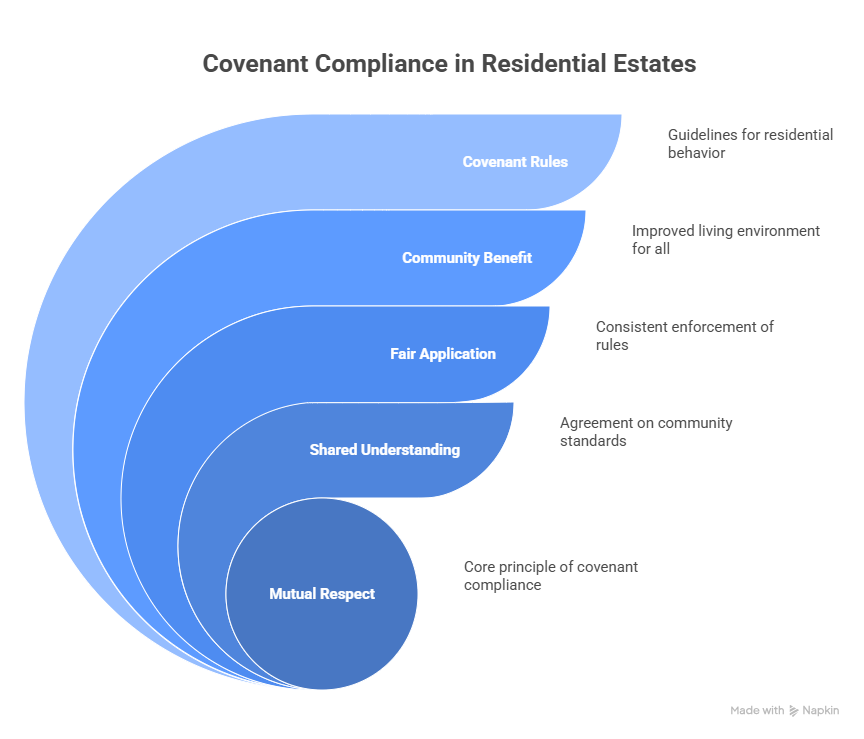
Problems arise when a small number of residents treat the covenants as if they do not apply to them. That can be unfair to neighbours, damaging to trust, and harmful to the character and value of the estate. If one household ignores the rules, it places pressure on others and weakens the shared understanding on which the estate depends.
In most cases, SPMC or the managing agent will first ask the resident to put matters right. This might mean stopping an activity, removing an obstruction, not using visitor parking as permanent parking, or stopping customer visits to a home business. If the issue is not resolved, SPMC may take further action, including formal correspondence, withdrawing any licence, recovering costs where permitted, or seeking legal advice. In serious or persistent cases, court action may be considered.
A covenant breach can also cause problems when selling, remortgaging or taking out a new mortgage. Buyers’ solicitors and lenders may ask about disputes, breaches, complaints, licences, waivers or enforcement action. An unresolved breach can delay a sale, make a buyer nervous, or raise questions about whether the resident can be trusted to comply with other legal commitments. Mortgage lenders can also be cautious where covenants affect the value or marketability of a property.
The covenants also help protect the appearance and value of the estate. Spofforth Park is a residential estate, not an industrial estate, commercial yard or overflow car park. If homes are used for customer-facing businesses, if commercial vehicles are stored inappropriately, or if visitor bays become private parking, the estate can quickly feel less residential. That can affect neighbours’ enjoyment of their homes and may make the estate less attractive to future buyers.
It is difficult to put an exact figure on the financial impact without local valuation evidence, but appearance, parking, estate management and neighbourhood character are all factors that influence buyer confidence and property value. Where an estate looks well cared for, properly managed and clearly residential, it is likely to be more attractive to buyers. Where it looks unmanaged, congested or commercialised, that can weaken confidence and reduce market appeal.
The purpose of managing the covenants is not to punish residents. It is to protect the estate, protect property values, avoid disputes, and make sure Spofforth Park remains a residential place to live.
The best approach is to deal with any issue early. If a resident thinks they may have breached a covenant, or needs permission for something, they should contact the managing agent before matters escalate. In some cases, a limited licence may be considered, but this is not automatic and will depend on the estate documents, the impact on neighbours, and whether the arrangement can be properly controlled.